
Loading the latest stories…
I was sure I didn’t much like spinning Targhee, nor did I love knitting socks. That is, until I came across a pair of socks so sensational that they called into question whether I knew myself at all.
Deborah Held3 min read
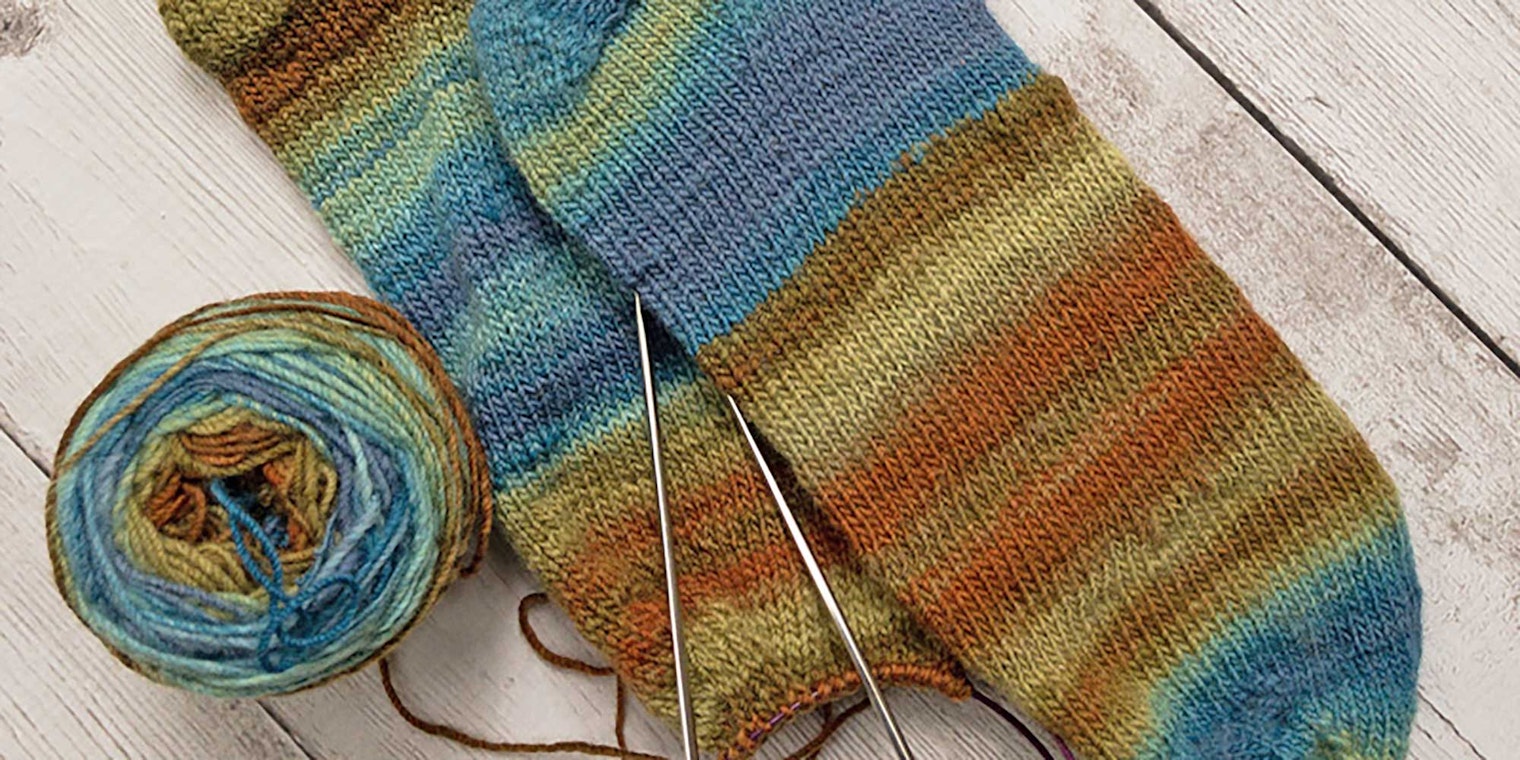
A couple of things I thought I knew about myself: I don’t love spinning Targhee as much as I do so many other sheep breeds and blends, and I’m not the biggest fan of sock knitting. I felt sure of this knowledge until a few days ago when I came across a languishing WIP, a pair of handspun, handknitted socks (in . . . Targhee) so completely sensational that they called into question whether I knew myself at all.
The socks were nearly complete, save for the toe of the second one. As I got to work on completing it, I was reminded of the positive feelings I’d initially had from both the spinning and knitting of this very pair of socks (plus knowledge gained since), and so I stand corrected: spinning Targhee, or even superwash Targhee (as was the case here), especially as a sock yarn, is actually a rewarding and stellar endeavor. I simply didn’t execute it all as well as I could have in this example, but that’s on me, not on Targhee.
 Debbie works to complete the toe of the socks that will ultimately become her mother’s (left) and uses the leftover yarn to cast on a pair of shortie socks for herself (right).
Targhee was developed by the USDA Sheep Experiment Station in Idaho in the 1920s with the intention of creating an “ideal” wool: soft yet durable with a distinguished hand. Crossed with 3/4 fine wool and 1/4 longwool, the resulting breed is Merino-soft, highly crimpy (for elasticity and memory), yet somehow both lofty and plush at the same time. For more about the Sheep Experiment Station, read “Your Tax Dollars at Wool: United States Sheep Experiment Station” by Susan Clotfelter in Spin Off Winter 2018.
Your socks will not only stay up, but the fabric itself is unlike any other handspun/handknitted of which I’m aware. When knit at a dense gauge and combined with the wool’s trademark matte finish, the fabric reminds me of the well-known, iconic German commercial sock yarns so many of us know and love. Your feet will thank you for years to come.
 Targhee’s locks are dense and uniform, with a lot of crimp. Photo by Matt Graves
Spinning-wise, Targhee is adaptable to any spinner’s form. Incredibly easy to draft, it can be spun worsted or woolen, or anywhere in between, with ease and equally good results. It accepts high-twist, as you can see here.
If you’ve had trouble spinning singles fine enough for a true sock-weight three-ply or chain-ply yarn, try again with some Targhee top. Its origin crossbreeds of Rambouillet, Corriedale, and Lincoln help to make this fiber an excellent choice for so many end projects. The superwash wool I used seems dense even in fiber form, and it will spin as thin as I want to go.
Simple. They don’t fit! They are too small for me, but hopefully my own error can help you avoid your own. I prefer to knit a 10-percent negative ease into the fit of my size 11 clodhoppers (so basically I knit to a true women’s size 10 sock), yet what I didn’t factor in here was precisely what made my handspun superwash Targhee so special in its completed form: its dense cloth. Elasticity, or memory, is not the same thing as stretch or give.
These socks have no give at all, but that’s okay. My mother, a size 9, will absolutely love them! Equally great, I still have plenty of yarn left for a pair of shortie socks for myself, which I have just cast on. Everyone’s a winner!
 The top sock has been washed to highlight the finished fabric.
And yes, perhaps I actually do enjoy knitting socks, but only within certain parameters: when knit with handspun yarn and plain “vanilla” knitting (no fancy stitchwork). I also like it when said socks fit me, but that’s normally not an issue.
Regardless, it’s great to be back in the sock-knitting saddle.
Do you have a favorite fiber for spinning into sock yarn?
Deborah Held has been committed to spinsterhood since 2012. She’s a freelance writer, author, and international and online fiber arts educator. She and her Persian cat, Stanley, live on an urban farm in Atlanta, Georgia, where a spinner’s flock of Shetland sheep roam beneath their windows. Find them at debbieheld.com.
Originally published July 6, 2018; updated December 25, 2023.
More from Spin Off
 Celebrate a Century of Targhee SheepThis beloved cousin of Merino turns 100 this year.Spin Off Contributors · July 22, 2026
 Targhee for Knitters and WeaversWhat makes Targhee a dream for knitters and weavers? Well, for starters, this springy, bouncy, medium-finewool holds its shape beautifully and is comfortable next to the skin.Maggie Casey · January 22, 2024
 Your Finished Object: Epic JacketA handspinner sets a goal to challenge herself, and the result is a stunning handspun, handwoven jacket, featuring cabled yarns.Barbara Daiker · June 2, 2021
 Twisted Love: An Artist Measures Twist & GristJoin Sahara as she talks about her approach creating yarns for a variety of projects.Sahara Briscoe · July 15, 2026
 Getting Started with Wool CombsJoin us as we start a new course with expert instructor Heavenly Bresser, and discover the secrets to successful wool combing.Pamela K. Schultz · July 8, 2026
 Spin Off Submissions Summer 2027: Summer BreezeTell us how you make summer spinning and fiber prep a breeze. Submit your idea for the Summer 2027 issue today!Pamela K. Schultz · July 6, 2026
 Wrapping Up 5 Ways to Prep and Spin a Braid As this course comes to an end, the Spin Off community reflects on colorful discoveries and celebrates the joy of learning through hands-on experimentation.Spin Off Editorial Staff · July 3, 2026
 Tour de Fleece 2026: Getting StartedWhether you want to spin a little or a lot, there’s space for you in the Tour de Fleece!Stefanie Johnson · July 1, 2026
 Choosing the Whorl to Make the Yarn You WantMake your wheel work for you by learning how ratios help you spin yarn with just the right amount of twist and thickness.Rudy Amann · June 26, 2026
 How to Use a Chain Plying BallChain plying got you down? Try a simple technique to help you make it easier!Pamela K. Schultz · June 24, 2026
Comments
No comments yet — be the first to share your thoughts.
Sign in to join the conversation — commenting is for signed-in members.