
Loading the latest stories…
These Queen of Diamond socks are brilliant, not only in their deep, rich color but also in their conception and toe-up construction. See how the author dyed, spun, and knitted this stunning pair, plus get the pattern!
Debbie Blair2 min read
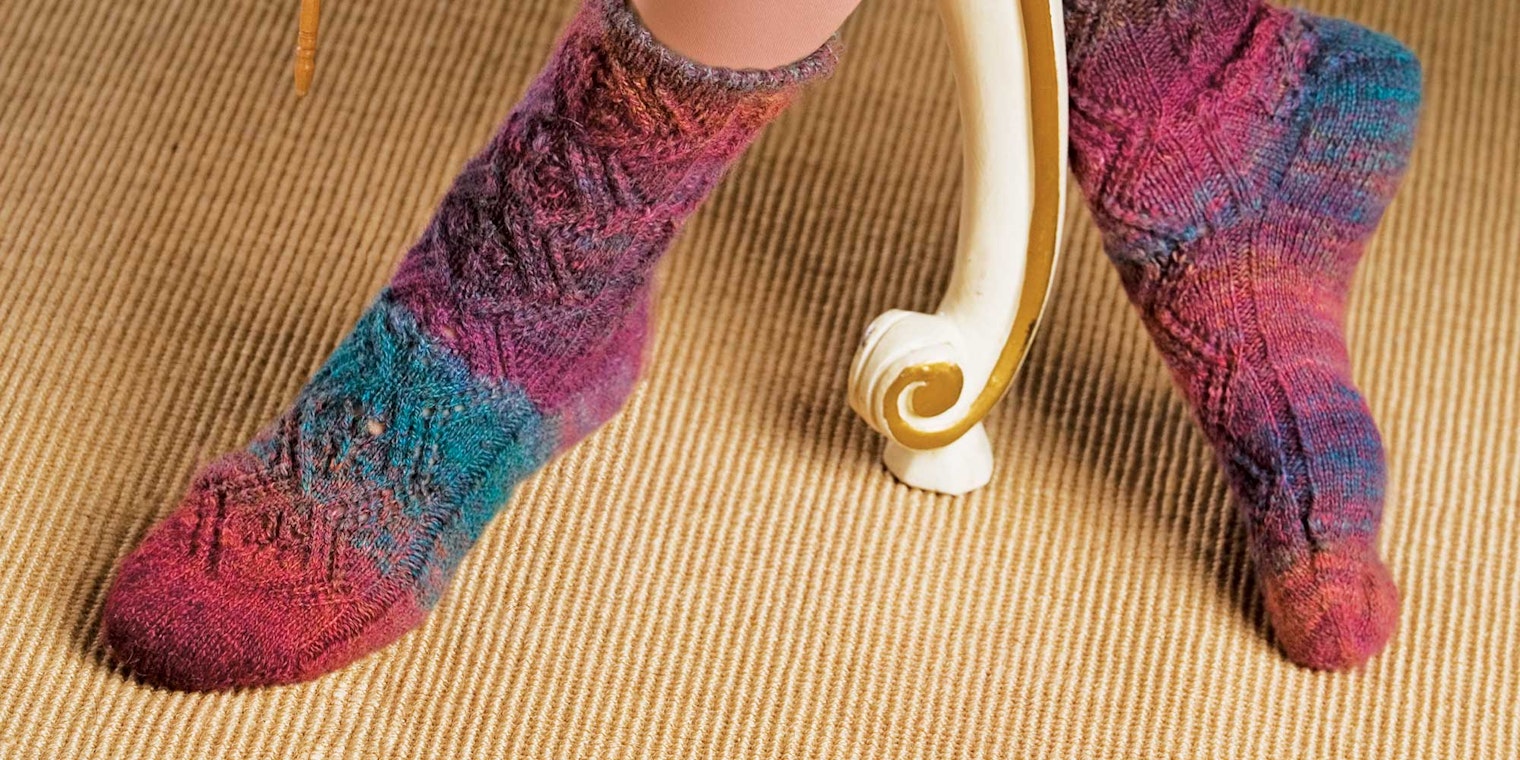
Using food and drink dyes can be an accessible and approachable way to try your hand at dyeing for the first time. While these dyes are often not considered to create deep, complex colors, Spin Off contributor Kristi Schueler clearly made it work! Keep in mind, more concentrated colors can be obtained by using gel dyes vs. liquid food coloring.
Kristi’s dyeing explorations resulted in a vivid, somewhat-striped yarn, which she then used to knit a fun pair of toe-up socks with diamond ribbing. We are excited to share Kristi’s article and toe-up sock pattern as this month’s subscriber bonus. Current Spin Off magazine subscribers can log in to access the downloadable PDF at the bottom of this post. Not a magazine subscriber? Learn more about all the perks.
Having had experience dyeing her own yarn, Kristi decided to try her hand at dyeing fiber using Kool-aid and Wilton’s food coloring. Kristi first consulted a color wheel to help her decide on colors. She filled condiment squeeze bottles two-thirds full with one part white vinegar and one part warm water. She then mixed her dyes using various food colors and Kool-aid packets, tweaking until she got the colors she wanted.
After splitting her BFL top in two and soaking it in lukewarm water with a bit of dish soap for several hours, Kristi squeezed out the moisture and then applied the dyes in wide sections, which resulted in a somewhat striped effect. She then steamed, rinsed, and hung the top to dry.
Interested in more content on dyeing with food and drink dyes? In her article Handpainting Fiber: Exploring Food and Drink Dyes, Spin Off contributor Sukrita Mahon describes her method of dyeing handpainted tops and shares lots of great step-by-step photos.
 Left: A close look at the predrafted BFL top; right: the long lengths of colors in the singles are apparent as they relax on the bobbin. Photos courtesy of Kristi Schueler
Kristi predrafted the fiber, then spun with a Z-twist using a semiworsted short-forward draw. Each section of top was spun on a single bobbin and then plied together to retain the color shifts created in the dyeing process. In the end, Kristi ended up with 350 yards of two-ply yarn with long gradual color shifts. Would the ombré effect become more apparant in the knitted pieces?
 Kristi says the ombré striping pattern attracted a lot of attention while she was knitting in public.
Kristi was nervous that she might not have enough yarn for knitting her standard socks, so she decided to use the toe-up sock knitting method using two circular needles. Kristi says, “The advantage of knitting from the toe up is that you can have the full pattern repeats no matter the length of the foot. It also allows you to make the most of the yarn you have and you can make the leg any length you desire as long as you have enough yarn.”
More from Spin Off
 A Stocking Study: Spinning Cotton for KnittingDevin found that handspun cotton yarn resulted in more elasticity and memory than commercial cotton yarns. How would this yarn work for socks, especially for someone who is used to knitting wool socks?Devin Helmen · October 2, 2024
 Sock Fiber Roundup: Fibers + Patterns!There are many fibers and blends that are great for socks, and pairing fiber and sock type can help your socks last.Kate Larson · September 4, 2024
 Your Finished Object: Frasier Fir SocksThis knitter set out to achieve a smooth color progression in her handspun yarn, using East Friesian fleece that she had dyed in two colorways and subsequently blended into six shades.Beate Fischer · August 27, 2024
 Spin Off Skill Guide: Spinning for Knitting (with a Twist)Love to knit? Check out these tips and tools to help you spin the perfect yarn for your knitted projects.Spin Off Editorial Staff · August 7, 2024
 What Is the Oldest Knitting in the “New World?”Historic knitting can challenge our spinning assumptions. Cotton for socks? A garter-stitch heel? Learn about the socks a community of sixteenth-century Peruvian knitters left behind—and more! Debbie Blair · May 24, 2024
 Your Finished Object: Colorful Helix SocksSee how one knitter spun random colors from various bits of leftover roving into colorful sock yarn, then used helical knitting for a fun striped pair of socks.Renee Strouts · May 13, 2024
 Knitting Traditions from Around the World: One Woman’s QuestIrene Waggener’s global travels inspire her spinning and knitting classes—including at this year’s SOAR event—her patterns, and even a book!Debbie Blair · March 1, 2024
 Color Your World!I was very excited to learn that the theme of this year’s spin-along is colorwork. Take a look at my collection of handknits and you’ll see that colorwork is so obviously my true fiber love!Stefanie Johnson · February 19, 2024
 Targhee for Knitters and WeaversWhat makes Targhee a dream for knitters and weavers? Well, for starters, this springy, bouncy, medium-finewool holds its shape beautifully and is comfortable next to the skin.Maggie Casey · January 22, 2024
 Her Handspun Habit: Why Targhee Makes For Great Handspun, Handknitted SocksI was sure I didn’t much like spinning Targhee, nor did I love knitting socks. That is, until I came across a pair of socks so sensational that they called into question whether I knew myself at all.Deborah Held · December 25, 2023
From the Library




Comments
No comments yet — be the first to share your thoughts.
Sign in to join the conversation — commenting is for signed-in members.