
Loading the latest stories…
Tunisian crochet is a bit like knitting with a crochet hook to create a woven fabric. Try pairing this easy technique with rare-breed wools!
A. Sabine Schröder-Gravendyck5 min read
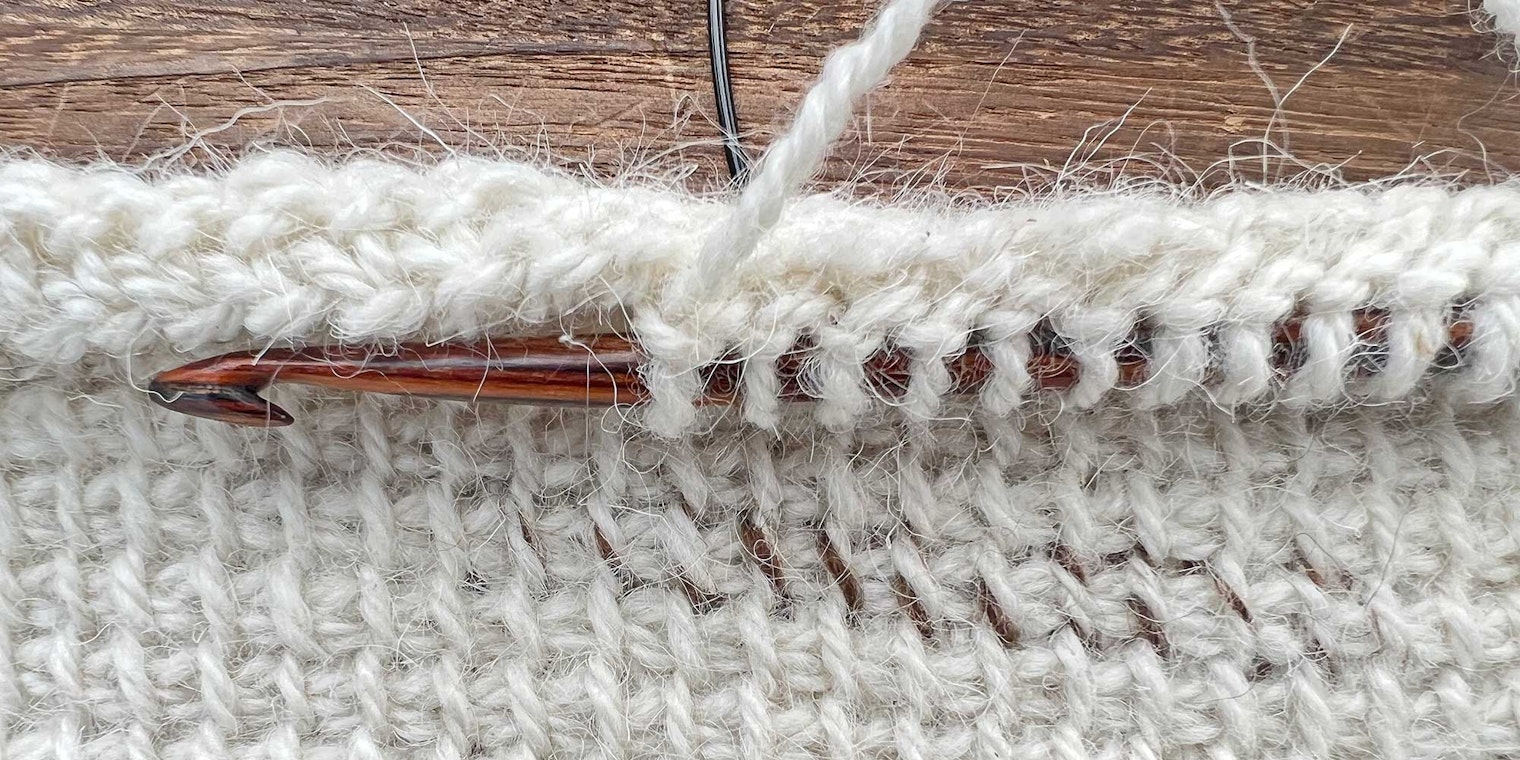
Editor’s note: Sabine’s Woolly Basket knitting pattern published in Spin Off Summer 2020 continues to be a reader favorite, so we asked her for another rare-breed friendly design. The Endlessly Adaptable Woolly Case in the Winter 2024 issue of Spin Off is a recipe that allows you to make a slipcase for any size device using any gauge of yarn using Tunisian Simple Stitch. Here’s Sabine to tell us what she loves about Tunisian crochet and a bit more about creating her Skudden-wool iPad case. And there’s a guide at the end for determining yardage needed to create your own sweet Woolly Case!
When working with a fleece, I love to create many small samples. I spin a few yards of singles, a few yards of two-ply, try adding more or less twist, and just get a feel for the fiber. I create tiny swatches using different stitch patterns and techniques, which often include Tunisian crochet. This fascinating technique produces a relatively firm material. You make one row of stitches in two passes so all stitches in a row are connected. This is different from crocheting where you make one independent stitch at a time. Additionally, each row of stitches is connected to the row below and the row above. The result is a special structure that is a bit woven-like. I enjoy the rhythm of this technique very much.
Tunisian crochet was a perfect match for the sturdy case I wanted to create for my iPad. Since all of our devices are different sizes and shapes, the pattern is easily adaptable for phones, tablets, and laptops.
 See three more rare-breed Woolly Cases in Spin Off Winter 2024. From left: Lincoln Longwool, Navajo-Churro, and Cotswold. Photo by Matt Graves
I worked with Skudden fleeces for my Woolly Case, and you can read more about the breed and how I prepared the fiber in last week’s post.
After sampling, I settled on a drafting technique that created the texture that I wanted. This was a “middle backward draw,” drafting roughly 3 inches backward with my fiber-supply hand, while pinching with the forward hand. I did not smooth the single as the twist was entering the drafted fibers.
I added some locks of the other white Skudden fleeces, and one ply received a flick-carded lock from the brown fleeces every now and then. I spun most of the yarn on a Louët Julia, ratio 18:1, and some on an Ashford Joy 2. My final handspun was a three-ply yarn that measured 8 wpi (wraps per inch).
 Sabine’s finished Woolly Case, designed to fit her iPad, measures 11.5" x 9.5" (30 x 24 cm).
I measured my iPad and then crocheted a swatch to determine the hook size and yardage needed (see below). Following the steps outlined in Spin Off Winter 2024, I crocheted the fabric and sewed it together. With a finished size of 30 x 24 cm, the bag fit my iPad perfectly. The edges of the flap ended up rolling up a bit; therefore, I reinforced the fabric by pulling yarn through the back of the fabric in a meandering pattern and stitching along the edge.
 Enforce the edge, then add the closure.
I made the buttons from slices of a sweet chestnut branch (can you spot the little star in the middle? It’s all natural). The closure is made with cabled yarn.
—Sabine
While it is exciting and liberating to create projects that don’t rely on a very specific set of instructions, spinners know that this approach also presents its own challenges. Wondering how much fiber and how many yards you need to spin for this Tunisian crochet project? Angela Schneider, Master Spinner and Spin Off’s project editor, will show you one way to estimate yardage based on a swatch. These calculations are done in metric because it is easier to calculate, but you can use Imperial if you prefer.
Now you’ll need to measure the device you would like to wrap in a cozy handspun case. See the full project in Spin Off Winter 2024 for instructions on measuring your device and adding a flap. For this example, let’s assume you need a quick estimate for the device below.
 C=width and D=height circumference. Illustration by Angela K. Schneider
Example:
Let’s say you spun a sample of 10 m that weighs 7 g, and you used it to crochet a swatch of 10 cm x 8 cm, with 15 cm of yarn left over. And you plan to create a bag that is 30 cm wide and 48 cm in circumference.
Grist: 7 g/10 m, which is 0.7 g/m.
Swatch meters: Ls = 10 m sample – 15 cm left = 9.85 m used.
Swatch area: Ts = 10 cm x 8 cm= 80 cm2.
Project total area: T = 30 cm x 48 cm = 1,440 cm2.
Project meters = T/Ts x Ls = 1440 cm2 / 80 cm2 x 9.85 m = 177 m.
Project fiber = 0.7 g/m x 177m = 124 g (which can be rounded up to 41/2 ounces)
Spinner’s math can feel complicated, but just take it one step at a time.
A. Sabine Schröder-Gravendyck, DVM, makes her home on Germany’s North Sea coast where she works as a naturalist and educator in sustainability and ecology. She is always looking for new ways to help people merge their personal spaces with nature. Learn more at florafauna.pro.
Angela K. Schneider is the project editor for Long Thread Media and an enthusiast for all the textile arts, especially when projects are layered with meaning.
More from Spin Off
 Twisted Love: An Artist Measures Twist & GristJoin Sahara as she talks about her approach creating yarns for a variety of projects.Sahara Briscoe · July 15, 2026
 Getting Started with Wool CombsJoin us as we start a new course with expert instructor Heavenly Bresser, and discover the secrets to successful wool combing.Pamela K. Schultz · July 8, 2026
 Spin Off Submissions Summer 2027: Summer BreezeTell us how you make summer spinning and fiber prep a breeze. Submit your idea for the Summer 2027 issue today!Pamela K. Schultz · July 6, 2026
 Wrapping Up 5 Ways to Prep and Spin a Braid As this course comes to an end, the Spin Off community reflects on colorful discoveries and celebrates the joy of learning through hands-on experimentation.Spin Off Editorial Staff · July 3, 2026
 Tour de Fleece 2026: Getting StartedWhether you want to spin a little or a lot, there’s space for you in the Tour de Fleece!Stefanie Johnson · July 1, 2026
 Choosing the Whorl to Make the Yarn You WantMake your wheel work for you by learning how ratios help you spin yarn with just the right amount of twist and thickness.Rudy Amann · June 26, 2026
 How to Use a Chain Plying BallChain plying got you down? Try a simple technique to help you make it easier!Pamela K. Schultz · June 24, 2026
 Fresh Bands, Smooth Spin How do you know when to replace your drive band or brake band?Amy Tyler · June 19, 2026
 Matching Your Combs to Your FiberIf your goal is perfectly aligned fibers for worsted spinning, combs have no equal. But how you select your combs and fiber matters, too.Heavenly Bresser · June 17, 2026
 Long Thread Podcast: Pamela K. Schultz, Spin OffSeason 14, Episode 10: As Spin Off nears 50 years old, editor Pamela K. Schultz sees herself as the host of a wonderful spinning party that welcomes one and all. Anne Merrow · June 13, 2026
From the Library




Comments
No comments yet — be the first to share your thoughts.
Sign in to join the conversation — commenting is for signed-in members.