
Loading the latest stories…
One spinner shares her real-world experience changing her whorl.
Sara Greer2 min read
Last fall, at a Sheep to Shawl team practice, our captain had us watch a video, Popular Wheel Mechanics with Judith MacKenzie. We viewed the segment called “Pulleys and Tension Adjustments,” and then we spent the afternoon trying to apply what we learned at our wheels. We fumbled through but kept trying.
The following week for the Spin Together competition, I decided I was going to spin using what I had learned from Judith. First, I selected my fiber braids, all Bluefaced Leicester (BFL) and BFL blends. I didn’t know how many I’d get through during the week-long event, but I wanted to be prepared. During this week, I also used the same wheel, a 1980s Louet S10, and the same drafting and treadling method, my default. The only variable I changed, other than location, was the whorl on my wheel.
For my first braid, which was 75% BFL and 25% nylon, I chose the 7.5:1 ratio. I made two bobbins of Z-twist singles, and then I plied them together using S-twist and the 5.5:1 ratio. This was the smoothest, most consistent yarn I had ever made. I started that braid on Saturday at noon, and I finished plying on Thursday at about 3 p.m. I didn’t spin any more that day.
I spun my second braid, 100% BFL, using a 10.5:1 ratio. The plan was to spin three Z-twist bobbins full of singles and ply them together in the S direction at a 7.5:1 ratio. I made it through the first bobbin and about one third of the way through the second during the final days of the event.
Using the same wheel and my default treadling and drafting speed, I saw that the singles spun at a 10.5:1 ratio had more twist than the singles spun at a 7.5:1 ratio, and the higher-ratio whorl turned the bobbin faster than the lower-ratio whorl, reinforcing what Judith taught me. Or in other words:
Let the above information sink in. It can change your spinning!

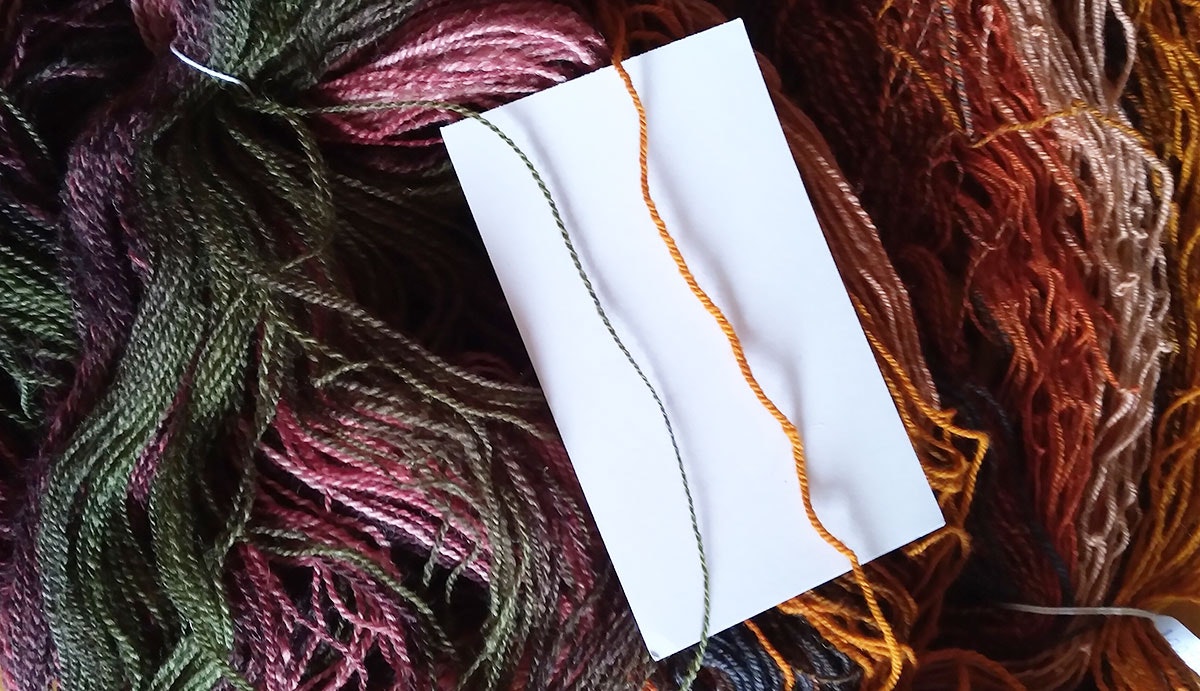
Left: Sara’s singles spun with a 7.5:1 ratio, yarn one. Right: Sara’s singles spun with a 10.5:1 ratio, yarn two. After measuring, Sara confirmed that the singles have the same grist.
I went on to finish the second yarn the following week. I made two very different singles with no change to my default spinning tendencies, which made the spinning more relaxing and enjoyable. The change in whorl size alone changed the singles thickness. But watch the video, and try this experiment on your own wheel.
Sara Greer began her fiber journey at age 19, with crochet. In the years since, she has learned to knit, dye, spin, and process many fibers; exotics are her favorite. She lives in Deer Trail, Colorado, with her husband, three kids, and an assortment of animals.
More from Spin Off
From the Library




Comments
No comments yet — be the first to share your thoughts.
Sign in to join the conversation — commenting is for signed-in members.