
Loading the latest stories…
Spinners can create complex colors in different ways. As a dyer, Alanna can mix dye stocks to create specific hues, but here, she explores how to apply that same approach to handcarded color.
Alanna Wilcox7 min read
Editor’s note: Alanna Wilcox is a fiber artist, author, and educator who encourages spinners to take a deep dive into color theory and experiment with blending to create complex colors in their spinning. In this All Access exclusive, Alanna walks you through three projects that explore how carding can be used to create specific color effects. Read on to learn more.
Working with color is one of my favorite aspects of spinning yarn. We can create color combinations and effects that a dyer just can’t match when applying dye to a commercially spun yarn. When it comes to color, we spinners can control both the fiber processing and yarn construction steps.
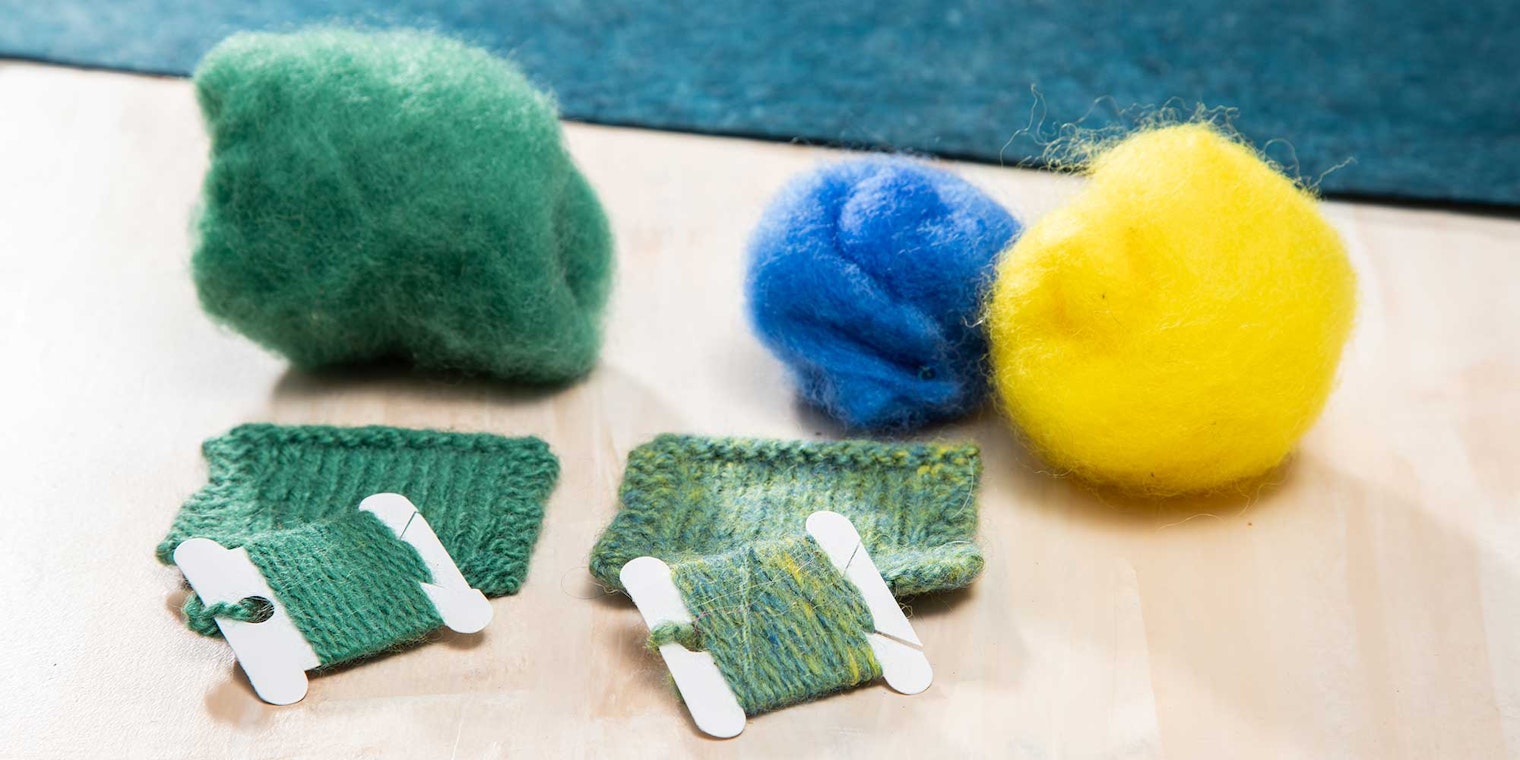
For example, we can start off with a dyed fleece and prepare it by either combing or carding it to create a specific color effect. Imagine that we start off using the colors blue and yellow and the resulting fleece has various spots of blue fiber, yellow fiber, and green fiber where the colors intermingle. The same color process could be applied to combed top, yielding completely different effects if blending is created through carding the combed top, splitting it into thinner strips to alter color sequencing, or a multitude of other techniques.
Color perception plays an equally important role in how blending colors (or choosing not to)—and the degree to which those fibers might be carded—can really create unique yarns. The closer together individual fibers of different colors get, the more difficult it is for our eyes to discern the difference. This perception of blending is called optical color blending.
 Note how the carded green color on the right is a complex, heathered color when you look at it close up.
You might also have observed this phenomenon when trying to spin a commercially dyed top that had several colors running parallel to one another, creating vertical color striations. When fiber like that is spun, the drafting and thinning out of the fiber makes those types of yarns appear more like a muddied solid color compared to the beautiful variations in the larger unspun preparation.
Working with color and fiber fascinated me so much that it was my focus for exploration when conducting my in-depth study while pursuing a Master Spinner certificate. The culmination of my coursework and final project can be seen in my book A New Spin On Color. As part of the coursework for the in-depth study, I created three garments after creating more than 20 different samples. I’ll share some of those samples and the garments with you here.
The first step in this endeavor was to choose colors. I selected a hand-dyed combed top that shifted from a dark blue into crimson on to a sunny yellow and ended with a spring green.
For All Access members
This article is part of All Access. Everything in your subscription, plus streaming video workshops and bonus eBooks.
You're not signed in.
More from Spin Off
 Comb a Rainbow of Colorful WoolAstonished and captivated by all the colorful wool on the market? What if you could create those luscious hues yourself, all without the use of a dye pot?Allison Korleski · April 4, 2023
 Flick Carding by Carol Huebscher RhoadesNo matter what your purpose is for flick carding, the one phrase to keep in mind throughout the process is “light and easy.”Carol Huebscher Rhoades · July 9, 2021
 Twisted Love: An Artist Measures Twist & GristJoin Sahara as she talks about her approach creating yarns for a variety of projects.Sahara Briscoe · July 15, 2026
 Getting Started with Wool CombsJoin us as we start a new course with expert instructor Heavenly Bresser, and discover the secrets to successful wool combing.Pamela K. Schultz · July 8, 2026
 Spin Off Submissions Summer 2027: Summer BreezeTell us how you make summer spinning and fiber prep a breeze. Submit your idea for the Summer 2027 issue today!Pamela K. Schultz · July 6, 2026
 Wrapping Up 5 Ways to Prep and Spin a Braid As this course comes to an end, the Spin Off community reflects on colorful discoveries and celebrates the joy of learning through hands-on experimentation.Spin Off Editorial Staff · July 3, 2026
 Tour de Fleece 2026: Getting StartedWhether you want to spin a little or a lot, there’s space for you in the Tour de Fleece!Stefanie Johnson · July 1, 2026
 Choosing the Whorl to Make the Yarn You WantMake your wheel work for you by learning how ratios help you spin yarn with just the right amount of twist and thickness.Rudy Amann · June 26, 2026
 How to Use a Chain Plying BallChain plying got you down? Try a simple technique to help you make it easier!Pamela K. Schultz · June 24, 2026
 Fresh Bands, Smooth Spin How do you know when to replace your drive band or brake band?Amy Tyler · June 19, 2026
From the Library


Comments
No comments yet — be the first to share your thoughts.
Sign in to join the conversation — commenting is for signed-in members.