
Loading the latest stories…
It’s been a while, but BeWeave It headquarters is back up and running again, and we couldn’t be more pleased. To kick off our new season of fun fiber facts and current events, we’re going to India to learn a bit about the spectacular embroidery of t
Christina Garton2 min read
It’s been a while, but BeWeave It headquarters is back up and running again, and we couldn’t be more pleased. To kick off our new season of fun fiber facts and current events, we’re going to India to learn a bit about the spectacular embroidery of the Banjara tribe of India.
Banjaran embroidery does not boast the figured motifs found in the needlework throughout much of India. There are no flowers or carefully stitched paisley patterns, and with very few exceptions, there are no animals, either. Instead, the Banjara create elaborate designs using simple shapes and line work. Outlines of circles, rectangles, zigzags, and squares are carefully stitched onto cloth and filled in with even more stitching. In some of the more elaborate textiles produced by the Banjara, nearly every inch of the surface is covered in stitching—it is truly astounding.
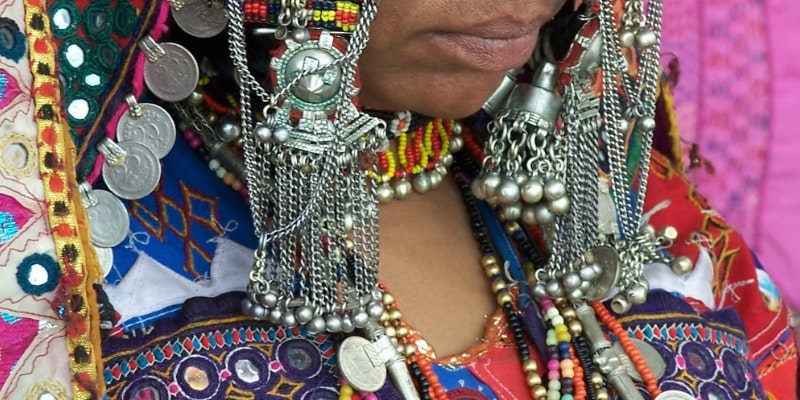
Alongside the thread, one can often find small mirrors known as shisha decorating the cloth—in some cases, the face of a cloth is almost entirely covered by shisha carefully embroidered in place. The most valued of these shisha are created using a technique that dates back to Roman times where molten glass is mixed with lead and zinc before being blown into a sphere. This sphere is then broken, and the shards are carefully cut into circles, squares, and other shapes. These handmade shisha are irregular in size and often feature bubbles and an uneven texture—it is these imperfections that make the shisha especially desirable to the Banjara.

A Banjara woman in traditional dress. Notice the large swaths of fabric covered in shisha. PHOTO BY DAVID B. ENGLAND
In fact, imperfection is a theme within Banjara textiles. To the casual observer, many of the embroidered designs look beautifully symmetrical, but upon closer inspection, there are often small areas of asymmetry or where a pattern briefly changes. Perhaps there’s one shape where the outline color doesn’t quite match the rest or a checkerboard pattern where two squares of the same color sit side by side. While these might look like careless mistakes or poor planning, in reality these bits are very purposefully placed. The Banjara believe that perfect cloth encourages hubris, and hubris is punished by divine forces. (This is a belief shared by many cultures—just look at the ancient myth of Arachne and Athena.) As a result, small imperfections find their way into these beautiful embroideries, adding to the intrigue.

Textiles of the Banjara by Charllotte Kwon and Tim McLaughlin.
Perhaps this is a lesson all weavers and fiber workers can take to heart. Instead of lamenting over uneven selvedges or treadling errors unseen until the cloth is off the loom, think of them as ways to stay humble and, hopefully, avoid a smiting. If you’re interested in learning more about the Banjara people and their cloth, check out the book
Textiles of the Banjara by Charllotte Kwon and Tim McLaughlin.
You can find a review of the book in this issue of Handwoven.Happy Weaving! Christina
Featured Image: Banjara Close Up Header, caption: Close-up of a Banjara woman, her blouse, and head covering. Notice the shisha mirror in the upper left corner. Unlike the other shisha mirrors this one is embroidered on using two different colors of thread. While this might look like a mistake, it’s actually a deliberate imperfection. PHOTO BY RAJESH DANGI
More from Spin Off
 A Short Spin on Natural DyeingSurprise and delight are often a given in natural dye experiments. But this author also found solace and healing.Linda Perry · April 24, 2026
 Meet the Jacob: Robin Lynde in Black and White (and Lilac)Meet the Jacob sheep, a rare breed known for its multiple horns and soft, lofty, spotted fleece that’s favored by handspinners.Robin Lynde · April 8, 2026
 Spin Off Submissions Spring 2027: Back to BasicsJoin us as we celebrate 50 years of Spin Off in our annual color issue.Pamela K. Schultz · April 1, 2026
 3 Reasons to Spin and Weave Your Own Bands (and an eBook to Help You Do It!)Find out why you should try spinning for bandweaving—plus get a handpicked collection of articles and projects to inspire your next band.Kate Larson · January 13, 2026
 Spinning for Bandweaving: 3 Ways to Weave Gorgeous RibbonsGet tips for spinning for woven bands, and check out our newest course! Kate Larson · December 31, 2025
 7 Tips for Knitting with Energized YarnIs there such a thing as too much energy in your singles? Discover the potential in energized singles, and find tips for working with them.Amy Tyler · December 26, 2025
 What is Back-Bar Crochet?The back bar has always been there, just waiting to be worked. Learn a new way to create a familiar stitch! Katrina King · November 19, 2025
 Are You Stuck on Superwash?Learn more about the superwashing process, and explore handspinner's options like preshrinking your knits. Cynthia Craft · October 13, 2025
 Ready for Texture? Try Garneting In This New Mini-CourseLearn how to spin luscious handspun textures using recycled bits of yarn, silk, and more! Spin Off Editorial Staff · July 3, 2025
 The Tour de Fleece Is Coming! Are You Ready?Even after many years, the goal of the Tour de Fleece remains the same: Challenge yourself. Spin. Have fun.Star Athena · June 18, 2025
From the Library

Comments
No comments yet — be the first to share your thoughts.
Sign in to join the conversation — commenting is for signed-in members.