
Loading the latest stories…
Revolutionary War reenactor Terri Drouin-Guerette shares some of her experiences showing people how to spin yarn at Old Sturbridge Village, a living history museum in Sturbridge, Massachusetts, in the Spring 2018 issue of Spin Off.
Terri Drouin-Guerette3 min read
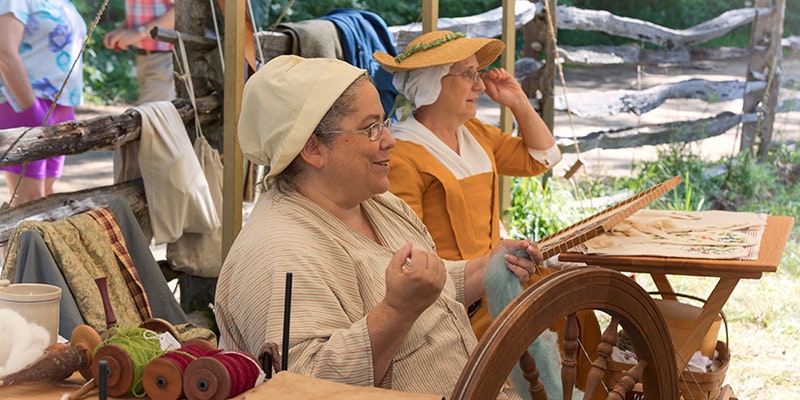
Learning to spin is no longer a necessity, and many folks don’t understand the mysterious process behind making yarn. Revolutionary War reenactor Terri Drouin-Guerette shares some of her experiences showing people how to spin yarn at Old Sturbridge Village, a living history museum in Sturbridge, Massachusetts, in the Spring 2018 issue of Spin Off.
These days, I spend a lot of time demonstrating spinning. Sharing the craft is such a wonderful experience. I encounter people from all levels of exposure to the fiber arts. There are those folks who walk up and, with great nostalgia, say, “Oh, I remember watching my mother/grandmother doing that!” No matter their experience level, almost everyone has questions. Men mostly ask about the mechanics of the wheel. I never thought that I would learn so much about mechanics and physics as I have since I started demonstrating spinning. Teaching and learning are always a give-and-take. Some men turn to their wives and ask, “Why don’t you do this?” If they only knew where such an innocent, teasing question could lead!

I teach children about spinning using a trick I learned: giving a child a hooked stick to teach about drafting and twist. Photos by Vicki Miorelli
I hear some questions that are probably common to all reenactors (or anyone who demonstrates spinning in public). Parents often tell their children to ask me what I’m doing. When they do, I ply back a length of singles and ask them what the resulting yarn looks like. Usually, after a little coaxing (“Does Mom or Grandma knit or crochet?”), they figure out that I’m making yarn.
Many children ask if they can try spinning on my wheel. While I hate to say no, it’s usually not very practical. Several years ago, another spinner showed me a hook that she uses to “turn kids into spinning wheels.” They learn to spin using an ancient but low-tech hook. After they have twisted and drafted for a time, I pull their yarn off the hook and ply it back onto itself. There’s nothing like the look on a child’s face when you hand it to them and declare, “Here you go, your very first yarn!”

Letting people feel the fiber I’m spinning shows them how soft wool can be.
I offer to let people feel the fiber that I’m spinning and, although I am not usually spinning anything particularly fine, they are often surprised by its softness. People ask how long it takes to fill up the bobbin, spin a pound of wool, or spin the batt that I’m working on. By starting with an empty bobbin at the beginning of my day, I can give them some frame of reference for the time involved.
—Terri Drouin-Guerette
Terri Drouin-Guerette learned a variety of fiber arts from her mom at a young age and began spinning in 2004. Terri teaches and demonstrates spinning and other fiber arts in many different settings, including living history events, schools, farm days, and fairs. Find her online at www.terrispins.com. Download a copy of the Spring 2018 issue of Spin Off and read the rest of Terri’s article, “My Life as a Revolutionary War Reenactor.” For tips on how to start teaching handspinning, read “3 Ways to Get Started Teaching People How to Spin Wool.”
Featured Image: Demonstrating spinning to the public during Redcoats and Rebels at Old Sturbridge Village, a living history museum in Sturbridge, Massachusetts.
More from Spin Off
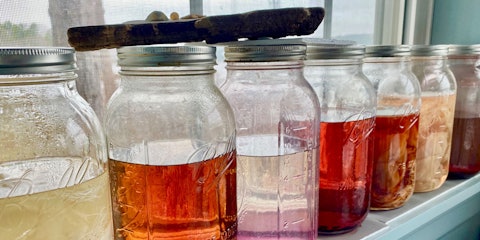 A Short Spin on Natural DyeingSurprise and delight are often a given in natural dye experiments. But this author also found solace and healing.Linda Perry · April 24, 2026
 Meet the Jacob: Robin Lynde in Black and White (and Lilac)Meet the Jacob sheep, a rare breed known for its multiple horns and soft, lofty, spotted fleece that’s favored by handspinners.Robin Lynde · April 8, 2026
 Spin Off Submissions Spring 2027: Back to BasicsJoin us as we celebrate 50 years of Spin Off in our annual color issue.Pamela K. Schultz · April 1, 2026
 3 Reasons to Spin and Weave Your Own Bands (and an eBook to Help You Do It!)Find out why you should try spinning for bandweaving—plus get a handpicked collection of articles and projects to inspire your next band.Kate Larson · January 13, 2026
 Spinning for Bandweaving: 3 Ways to Weave Gorgeous RibbonsGet tips for spinning for woven bands, and check out our newest course! Kate Larson · December 31, 2025
 7 Tips for Knitting with Energized YarnIs there such a thing as too much energy in your singles? Discover the potential in energized singles, and find tips for working with them.Amy Tyler · December 26, 2025
 What is Back-Bar Crochet?The back bar has always been there, just waiting to be worked. Learn a new way to create a familiar stitch! Katrina King · November 19, 2025
 Are You Stuck on Superwash?Learn more about the superwashing process, and explore handspinner's options like preshrinking your knits. Cynthia Craft · October 13, 2025
 Ready for Texture? Try Garneting In This New Mini-CourseLearn how to spin luscious handspun textures using recycled bits of yarn, silk, and more! Spin Off Editorial Staff · July 3, 2025
 The Tour de Fleece Is Coming! Are You Ready?Even after many years, the goal of the Tour de Fleece remains the same: Challenge yourself. Spin. Have fun.Star Athena · June 18, 2025
From the Library
Comments
No comments yet — be the first to share your thoughts.
Sign in to join the conversation — commenting is for signed-in members.