
Loading the latest stories…
I’m not all that particular about measurements, but I know that I prefer the viscosity of using a 3:1 ratio of oil to beeswax. Start with 1 ounce of beeswax and 3 ounces of oil to see how you like your first batch of natural spinning wheel conditioner.
Deborah Held3 min read
Ah, spring. Now is the perfect time to throw open the windows, listen to the birds sing, and delve into some seasonal cleaning—of the spinning equipment variety. (Let’s not get crazy . . .)
Central to any day of caring for your spinning tools is a basic wood balm or conditioner, which is not to be confused with any wood or wood-cleaning product containing sealant (often labeled as “polish”). A natural wood conditioner moisturises, and thereby enhances and protects, the appearance of the beautiful woods used in spinning wheels, spindles, kates, etc. By contrast, a sealant coats and seals off the top layers of wood. Sealed wood has a harder time accommodating the fluctuating changes in temperature and humidity in your home environment.
Condition your wooden spinning wheels and other tools at least yearly to prolong their life and to help stave off cracking, warping, splitting, and more. (The tools will have beautiful sheen, too, with no waxy buildup.)
All-natural wood balms and butters are available all over the internet, but if you’re like me, you’d rather spend that $15 on something else (fiber). Plus, this stuff is so incredibly simple to make at home for mere dollars that I thought I’d share my own process for making homemade spinning wheel/wood conditioner. (Bonus: The recipe makes enough to give a jar as a gift to a spinning pal.)
I like to stash these pots of balm throughout my home and use them them for pretty much everything: polishing cutting boards and other wooden utensils and also to dab on my lips, hands, and elbows as needed. While I am neither a chemist nor a dermatologist, I do have outrageously sensitive skin and can attest to the fact that this natural product is as safe as the ingredients you put into it.
I’m also not all that particular about measurements, but I know that I prefer the viscosity of using a 3:1 ratio of oil to beeswax. Start with 1 ounce of beeswax and 3 ounces of oil to see how you like your first batch of natural spinning wheel conditioner. If the consistency feels too firm for your liking, you can increase to a 4:1 oil to wax ratio.

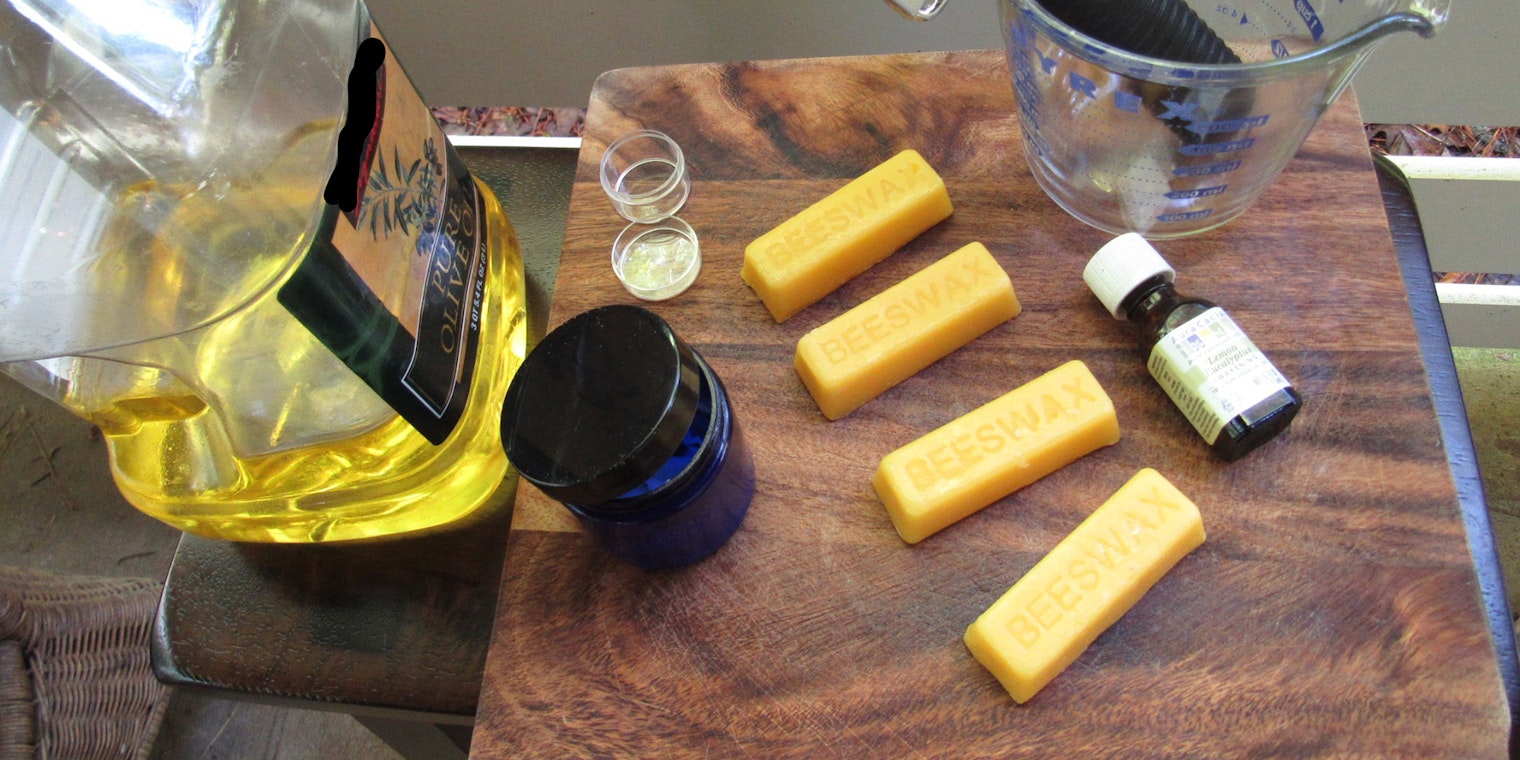
Clockwise from top left: For best results, grate your beeswax before melting or buy it as pellets. Melt the ingredients in a double boiler, or hot water bath, until they meld into one liquid. Emptied candle tins, plastic vials, and jars, ready to be filled with wood conditioner.

A finished pot of my all-natural spinning wheel conditioner sits alongside some of its ingredients. (Note the new life given to the wood spoon where it was used to stir the mixture.)
For added fun, create some labels!
To use: gently rub a bit of conditioning butter onto your wood items. Let sit for at least 15 minutes, then buff off with a gentle cloth.
Have you ever made your own spinning wheel conditioner? What ingredients did you use?
—Deborah Held
Featured Image: Everything I need to make a generous amount of spinning wheel conditioner. Photos by Deborah Held
More from Spin Off
 A Short Spin on Natural DyeingSurprise and delight are often a given in natural dye experiments. But this author also found solace and healing.Linda Perry · April 24, 2026
 Meet the Jacob: Robin Lynde in Black and White (and Lilac)Meet the Jacob sheep, a rare breed known for its multiple horns and soft, lofty, spotted fleece that’s favored by handspinners.Robin Lynde · April 8, 2026
 Spin Off Submissions Spring 2027: Back to BasicsJoin us as we celebrate 50 years of Spin Off in our annual color issue.Pamela K. Schultz · April 1, 2026
 3 Reasons to Spin and Weave Your Own Bands (and an eBook to Help You Do It!)Find out why you should try spinning for bandweaving—plus get a handpicked collection of articles and projects to inspire your next band.Kate Larson · January 13, 2026
 Spinning for Bandweaving: 3 Ways to Weave Gorgeous RibbonsGet tips for spinning for woven bands, and check out our newest course! Kate Larson · December 31, 2025
 7 Tips for Knitting with Energized YarnIs there such a thing as too much energy in your singles? Discover the potential in energized singles, and find tips for working with them.Amy Tyler · December 26, 2025
 What is Back-Bar Crochet?The back bar has always been there, just waiting to be worked. Learn a new way to create a familiar stitch! Katrina King · November 19, 2025
 Are You Stuck on Superwash?Learn more about the superwashing process, and explore handspinner's options like preshrinking your knits. Cynthia Craft · October 13, 2025
 Ready for Texture? Try Garneting In This New Mini-CourseLearn how to spin luscious handspun textures using recycled bits of yarn, silk, and more! Spin Off Editorial Staff · July 3, 2025
 The Tour de Fleece Is Coming! Are You Ready?Even after many years, the goal of the Tour de Fleece remains the same: Challenge yourself. Spin. Have fun.Star Athena · June 18, 2025
From the Library
Comments
No comments yet — be the first to share your thoughts.
Sign in to join the conversation — commenting is for signed-in members.