
Loading the latest stories…
How one handspinner takes inspiration from a Japanese textile tradition and uses every precious bit of leftover yarn from her knitting projects to craft beautiful woven projects.
Sarah Wroot3 min read
The beautiful Japanese textiles created when hard-worn indigo fabrics are mended time and again are known collectively as boro, which comes from the Japanese term boromono, roughly meaning “rag things.” The philosophical basis of boro textiles stems from the Japanese concept of mottanai, the idea that nothing should be wasted. This concept speaks to my understanding as a spinner and weaver that textiles are valuable. Now when I look back, I realize that, as a handspinner, I understood the concept of mottanai long before I learned the word.
I love spinning fine yarn. It makes the most of luxury fibers, such as cashmere and silk, and there’s a real sense of accomplishment as yard after yard of fine, consistent yarn flows onto the bobbin. Fine yarns spun from hand-dyed luxury fibers shine in knitted lace.
Before I learned to weave, I knitted a lot of lace shawls. I had to do something with all that yarn! There were far too many shawls to keep, let alone use, so I gave most of them away. Eventually, I didn’t even photograph or record them on my Ravelry project pages. But I had the leftover yarn to remember them by.

Spun on a spindle while Sarah travelled, some cashmere/silk spinning fiber she bought at her first Spin Off Autumn Retreat (SOAR) became an Echo Flower shawl.
My bag of odd balls of yarn grew larger until, as a new and enthusiastic weaver, I decided to combine them all as a warp on my new loom. What could go wrong? Almost everything. This was a bad idea for so many reasons! If I’d known more about weaving, it would have been easier, or I wouldn’t have done it at all.
The most significant problems were:
But I persevered and that fabric became a waistcoat.

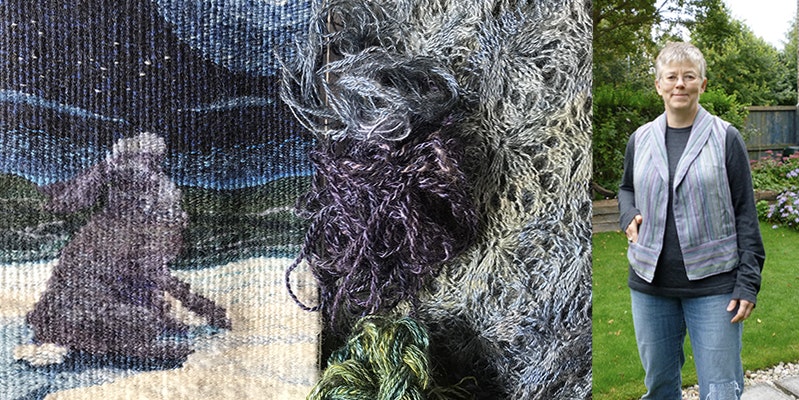
Sarah’s handwoven fabric, which became a waistcoat. Every color is yarn from a shawl, or intended for a shawl, except for the lilac silk singles, which was a mistake but found a final home here. Each yarn reminds Sarah of a shawl. The dark purple was a shawl she gave to a friend on the steps of the British Museum, the bright green was weft from the Spring Flood shawl given to her sister, the blue-green silk/Merino was the Simurgh shawl she gave to a neighbor recovering from cancer.
I offer the following advice so readers can learn from my experience: As a new weaver, I did not know at the time that sizing the skeins of yarn before winding the warp, sizing the wound warp, or even painting the sizing on the exposed warp while on the loom would have reduced the fuzziness and made it much easier to weave.

Sarah used the thrums from her warp to weave tapestry of a hare. A white silk moon shines from a sky of indigo cottons and silks. Low hills of green and indigo silk rise behind a hare in purple cashmere and silk, as it sits on a snowfield of blue and white silks and wools, gazing back at the moon.
After using my handspun for weaving, I had a bag of thrums, short lengths of waste yarn from that warp, the last remnants of my laceweight yarns and shawls. Still too precious to discard, the little bag of memories sat in a box until I started to weave tapestry. I discovered that thrums are the perfect length and weight for the small images I wanted to create.
Waste nothing!
Sarah Wroot is a contributor to PieceWork and Spin Off magazines, and she records her textile explorations at www.wroot.com.
More from Spin Off
 Long Thread Podcast: Pamela K. Schultz, Spin OffSeason 14, Episode 10: As Spin Off nears 50 years old, editor Pamela K. Schultz sees herself as the host of a wonderful spinning party that welcomes one and all. Anne Merrow · June 13, 2026
 7 (Plus) New Ways to Use Your HandspunLooking for a new way to use your handspun? Check out these options that go beyond knit and crochet!Spin Off Editorial Staff · March 18, 2026
 What Spinners Need to Know Before Weaving the Autumn Jewel Scarf (Or Pillow)Woven on only four shafts, the Autumn Jewel Scarf has fantastic texture and offers lots of lessons for combining handspun wool and millspun cotton in a warp. Plus, some tips for cutting and sewing your handspun handwovens.Pamela K. Schultz · January 23, 2026
 3 Reasons to Spin and Weave Your Own Bands (and an eBook to Help You Do It!)Find out why you should try spinning for bandweaving—plus get a handpicked collection of articles and projects to inspire your next band.Kate Larson · January 13, 2026
 Spinning for Bandweaving: 3 Ways to Weave Gorgeous RibbonsGet tips for spinning for woven bands, and check out our newest course! Kate Larson · December 31, 2025
 Long Thread Podcast: Sahara Briscoe, Creative MulticrafterSeason 13, Episode 3: Stretching the possibilities of fiber and craft, Sahara advocates for living beautifully with yarn in all its states.Anne Merrow · October 18, 2025
 Something from Nothing: Making Cordage from the GardenLearn how to twist cordage, plus find two projects for your garden cordage!Devin Helmen · June 25, 2025
 What Do Yarn Numbers Mean? Weaving YarnsWonder what the numbers such as 5/3 or 2/20 mean in weaving yarn? Amy Tyler has the answers.Amy Tyler · May 19, 2025
 Cashmere, Glaciers, and a Fiber Contest with Global ImpactDid you know that cashmere and other fine fibers rely on glaciers?Spin Off Editorial Staff · May 9, 2025
 Singles Warp? Yes, You Can!Linda Ligon addresses some old wives’ tales that have been making the rounds since she started spinning and weaving.Linda Ligon · May 5, 2025
From the Library
Comments
No comments yet — be the first to share your thoughts.
Sign in to join the conversation — commenting is for signed-in members.