
Loading the latest stories…
Get started weaving with small rigid heddles! Spin Off editor Kate Larson will show you how to warp and weave a handspun band in this tutorial. You’ll be weaving sweet bands, ribbons, and ties in no time.
Kate Larson4 min read
I love portable projects that can move with me out in the world. Just like my spindles or book charkha, a small rigid heddle used backstrap-style to weave narrow bands can be used just about anywhere.
I’ve woven bands on hikes in the forest, in my barn with lambs bouncing about, through meetings and lectures, and in random hotels when I needed a bit of peace. Today I’ve been weaving in my greenhouse on a very cool spring morning, seated in a chair, but you can also stand or sit on the ground to weave in this method. All you need to do is tie the far end of the warp to something secure and the near end of the warp to your belt. With backstrap weaving, you are part of the loom—a beautiful thing.
 Kate weaving a simple plain-weave band in her greenhouse using a small 13-thread rigid heddle from TheDancingGoats.
Plain weave bands are super easy to learn to warp and weave, and I’ll show you the basics in a short tutorial. Patterned bands created with a pick-up technique look much more complicated, but after learning how to create plain-weave bands, pick-up only requires a few more skills.
This type of traditional bandweaving is just so much fun, and it only takes a little time, a small amount of yarn, and a few tools to get started. Will you join me?
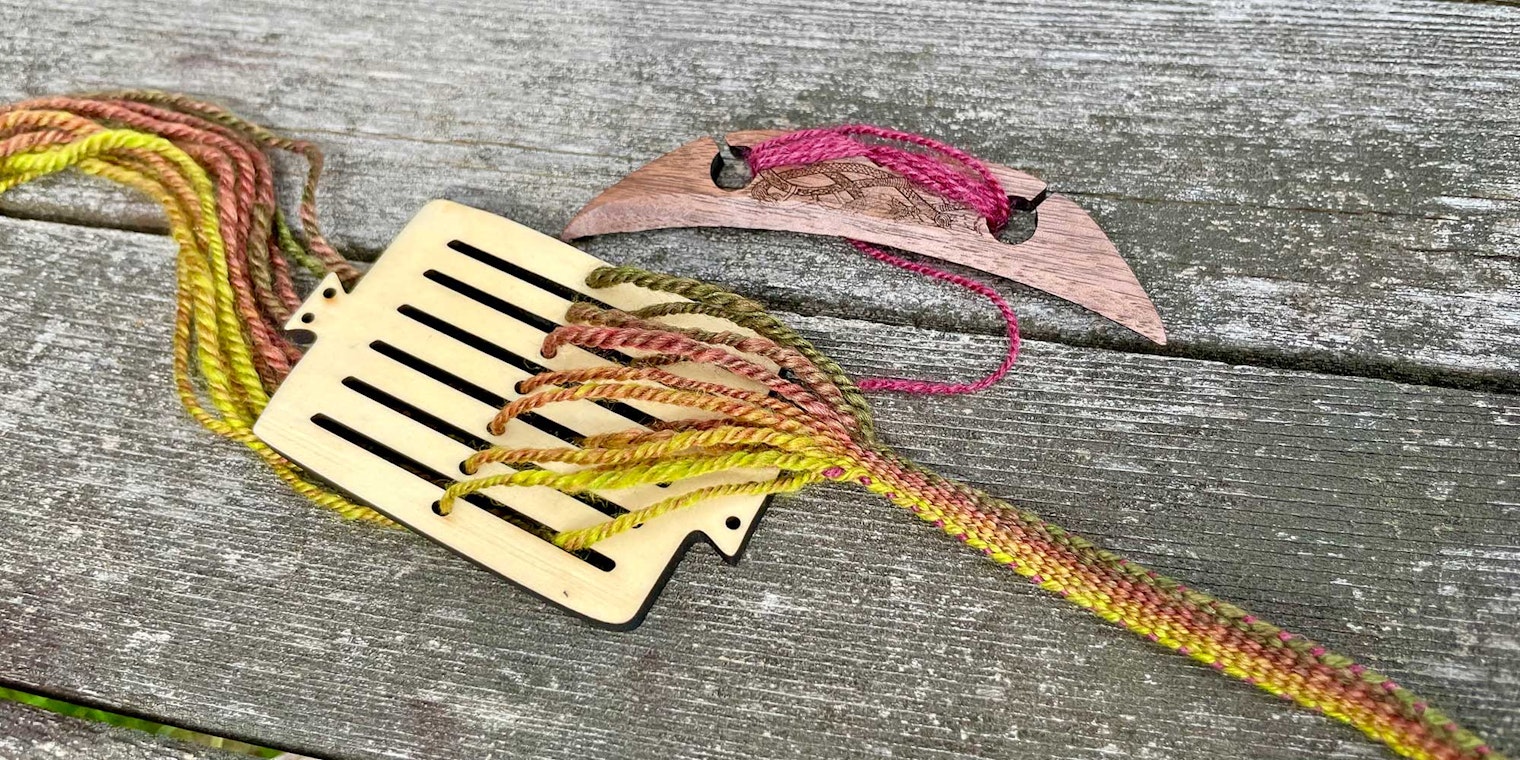
You’ll first need a rigid heddle and shuttle. These traditional tools come in all shapes and sizes, ranging from simple to ornate. Especially when getting started, having a lightweight heddle is really helpful. The two shown below are very lightweight, smooth, and snag-free. Both are made by Robin Goatey, the maker behind TheDancingGoats.
The small 13-thread heddle (below, left) is based on a French example from the Roman Era. I love having that historical connection with a sweet tool that is small enough to tuck into my pocket! The larger heddle (below, right) is a 25-thread Scandinavian-style heddle. Made in maple plywood, it is amazingly strong and lightweight for its size.
The shuttle I’ve been using a lot lately (also below, left) is one of Robin’s short, curved shuttles in walnut. It fits just so in my hand, and the inside curve has a beveled edge that makes beating the weft in place easy. The pointed ends allow me to use either end of the shuttle to select threads when working pick-up patterns.
The other tools and supplies needed can be mostly be gleaned from around your home. I cover some of the “make-do” options in the tutorial.
In the video below, I’m weaving two different bands: plain-weave (shades of green) and pick-up (white and red). Plain-weave bands are simple to warp and weave, and I’ve created the different colors in the warp here using only one ball of yarn. I spun a hand-painted braid into fine singles, and then used chain-plying to pool the colors. I spun the weft as a finer single and used a 2-ply construction.
 Kate wove a plain-weave band using the smaller 13-thread heddle (left) and a pick-up patterned band using the larger Scandinavian-style heddle. Photos by Kate Larson
For pick-up patterns like I used here to create a red and white patterned band, the pattern threads (red) need to be at least twice as large as the background threads (white). An interesting thing I’ve learned by band sleuthing in museum collections is that Norwegian bands often have a different twist direction in pattern versus background threads. Here, my red, 2-ply threads have a S-ply twist, and my white charkha-spun cotton threads are 2-ply with an Z-ply twist.
There is so much more to explore when combining factors such as fibers, colors, patterns, twist direction, weft to warp size, and more. Luckily, short bands require such a small amount of yarn and time that you can quickly try different combos.
See Spin Off Spring 2023 or the new Bandweaving: Using Rigid Heddles and Inkle Looms eBook for more inpiring ideas for your handmade bands.

TheDancingGoats makes historic and prehistoric reproductions, and re-imaginings of fiber arts tools. Focusing on the prehistoric textile traditions of the Northern Roman Provinces, the Northern Isles, and Western Europe. Shuttles, heddles, looms, spindles, and whorls. Tools are made in wood, stone, pewter, copper alloys, ceramics, and glass. The company’s advanced CNC Laser is dedicated to making fiber arts tools and folklore inspired creations. TheDancingGoats business model is Inspired by Albrecht Durer’s life, journals, and his Nuremberg School. Learning, teaching and practicing the Heritage Arts since 1987. Learn more at TheDancingGoats.Etsy.com.
Kate Larson, editor of Spin Off, teaches handspinning around the country and spends as many hours as life allows in the barn with her beloved flock of Border Leicesters.
More from Spin Off
 A Short Spin on Natural DyeingSurprise and delight are often a given in natural dye experiments. But this author also found solace and healing.Linda Perry · April 24, 2026
 Meet the Jacob: Robin Lynde in Black and White (and Lilac)Meet the Jacob sheep, a rare breed known for its multiple horns and soft, lofty, spotted fleece that’s favored by handspinners.Robin Lynde · April 8, 2026
 Spin Off Submissions Spring 2027: Back to BasicsJoin us as we celebrate 50 years of Spin Off in our annual color issue.Pamela K. Schultz · April 1, 2026
 3 Reasons to Spin and Weave Your Own Bands (and an eBook to Help You Do It!)Find out why you should try spinning for bandweaving—plus get a handpicked collection of articles and projects to inspire your next band.Kate Larson · January 13, 2026
 Spinning for Bandweaving: 3 Ways to Weave Gorgeous RibbonsGet tips for spinning for woven bands, and check out our newest course! Kate Larson · December 31, 2025
 7 Tips for Knitting with Energized YarnIs there such a thing as too much energy in your singles? Discover the potential in energized singles, and find tips for working with them.Amy Tyler · December 26, 2025
 What is Back-Bar Crochet?The back bar has always been there, just waiting to be worked. Learn a new way to create a familiar stitch! Katrina King · November 19, 2025
 Are You Stuck on Superwash?Learn more about the superwashing process, and explore handspinner's options like preshrinking your knits. Cynthia Craft · October 13, 2025
 Ready for Texture? Try Garneting In This New Mini-CourseLearn how to spin luscious handspun textures using recycled bits of yarn, silk, and more! Spin Off Editorial Staff · July 3, 2025
 The Tour de Fleece Is Coming! Are You Ready?Even after many years, the goal of the Tour de Fleece remains the same: Challenge yourself. Spin. Have fun.Star Athena · June 18, 2025
From the Library
Comments
No comments yet — be the first to share your thoughts.
Sign in to join the conversation — commenting is for signed-in members.