
Loading the latest stories…
Spin Off contributor Brian McCarthy learned to spin shortly after his retirement. Soon he became fascinated with natural dyeing and Navajo plying.
Brian McCarthy3 min read
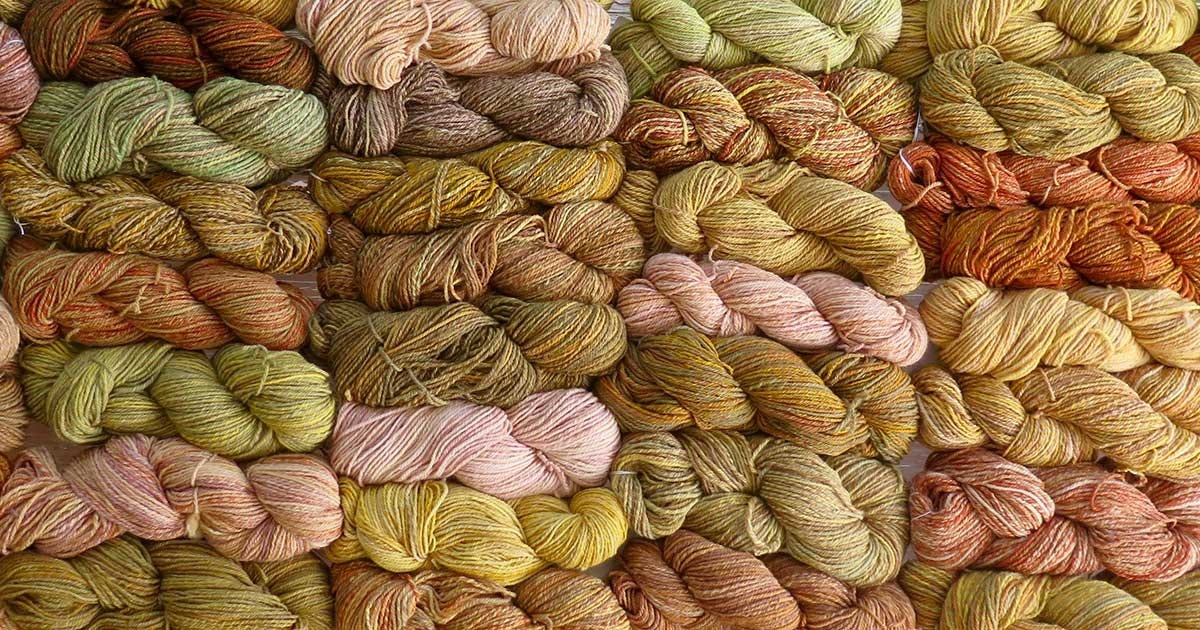
Spin Off contributor Brian McCarthy learned to spin shortly after his retirement. Soon he became fascinated with natural dyeing and Navajo plying. In the Winter 2019 issue, Brian shared his interest with seeing what colors he could obtain from the plants he encountered in his environment and the resulting afghan projects were inspired by the Australian Outback.

Aerial image of the Australian Outback. Photos by Brian McCarthy
It did not take long for it to dawn on me that there was a strong correspondence between the colors extracted from plants and those dominating the landscapes of the Australian Outback: the parched, hardy grasses and scrub of the plains; the salt pans and dry watercourses; the ochre sand dunes; and the rocky ridges, gorges, and escarpments of stark, barren ranges.
I began a series of projects to evoke the natural scenery of the Outback using naturally dyed fiber and handspun yarn.

Outback afghan 1.
Outback 1 was a mosaic constructed from 252 mitered squares worked on 6.5 mm (U.S. size 10½ ) needles. The center includes all 56 of the initial colorways. The mitered squares automatically generate a series of right-angled stripes that gradually reduce to blotches of color as the rows become shorter, and the diagonal ridge created by the central double decrease creates a three-dimensional effect. The finished, blocked work measures 110 by 140 centimeters (43 by 55 inches) and weighs about 1,270 grams (45 ounces).
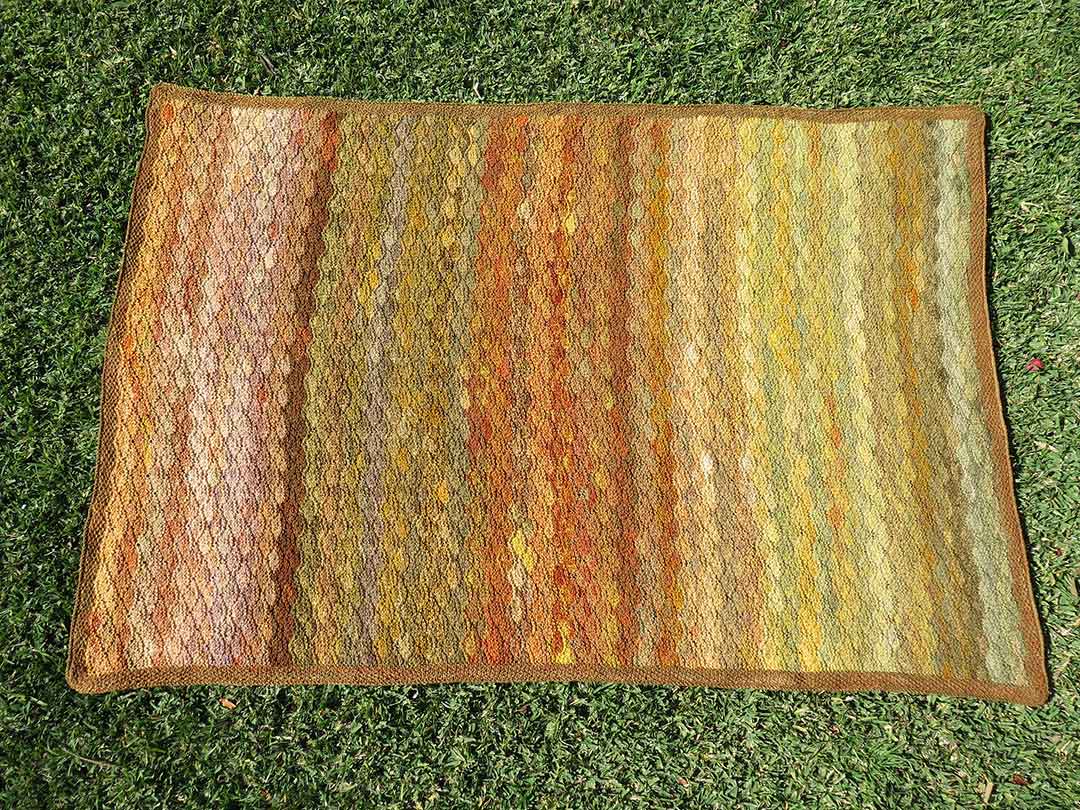
Outback afghan 2.
Outback 2 represents the transition from grass to desert to dark escarpment to an evening sky. It is built on the short-row color-pooling pattern used in the Autumn Forest Afghan. The center, using 46 of the colorways, was worked on 6.5 mm needles (affiliate link) as a single piece on 183-stitch rows to emphasize the flatness of the landscape; each band was a single set of the 4-row pattern. The finished, blocked piece measures 121 by 174 centimeters (48 by 68.5 inches) and weighs about 1,400 grams (49 ounces).
By the time the first two afghans were finished, supplies of some of the colorways were already beginning to run low, so the remaining pieces represent experiments with color and texture.

Outback afghan 3.
Outback 3, knitted on 6.5mm needles, is constructed in one piece using garter-stitch, garter-rib, and seed-stitch blocks spread across 152-stitch rows, with 15 stitches across each block. For this project, I divided the colorways into three broad classes: brown, green, and orange. The entire center is built on a sequence of one row green, one row brown, one row orange, carrying the yarn up the side. After each 24-row band there is a change of the particular green, brown, and orange set of colorways, and the stitch sequence is shifted across by one block (i.e., garter stitch, garter rib, seed stitch in band 1 would become garter rib, seed stitch, garter stitch in band 2). The finished, blocked work measures 107 by 152 centimeters (42 by 60 inches) and weighs about 1,050 grams (37 ounces).

Outback afghan 4.
Outback 4 consists of a textured stitch pattern with 33 of the center colorways transitioning as they might in an outback landscape. It was knitted on 6.5 mm needles across 170-stitch rows. The finished, blocked work measures 114 by 161 centimeters (45 by 63 inches) and weighs about 1,050 grams (37 ounces).

Outback afghan 5.
Outback 5 is knitted using a garter slip-stitch pattern across 193-stitch rows with a vague transition from greens through oranges to brown. This stitch adds texture and density by compressing the work both horizontally and vertically and by producing “feature” stitches carried over two rows. Unless a larger-than usual needle is used (8 mm [U.S. size 11], such a pattern creates a stiff, drape-impaired fabric. In order for the seed-stitch border to match the spring and density of the body of the afghan, I worked it with a double strand of yarn, also on 8 mm needles. The finished, blocked work measures 118 by 162 centimeters (46.5 by 64 inches) and weighs about 1,350 grams (48 ounces).
—Brian McCarthy
Brian McCarthy lives on the south coast of New South Wales. He is a lifelong knitter who took up spinning on retirement after touching a skein of handspun Merino that made him realize just what he had been missing. Various corners of the house now serve as workstations for scouring, carding, spinning, knitting, dyeing, and stash storage. His very patient wife, four children, and nine grandchildren have ended up with a lot of handspun jumpers, shawls, scarfs, and afghans.
Featured Image: Overall, the Outback Afghan Project required 11,470 meters (12,540 yards) of Navajo-plied yarn (i.e., 34,410 meters of singles!) weighing 6.87 kilos (242.3 ounces), a total of 56 skeins for the afghan centers and 2 or 3 more for each mitered-corner seed-stitch border.
More from Spin Off
 A Short Spin on Natural DyeingSurprise and delight are often a given in natural dye experiments. But this author also found solace and healing.Linda Perry · April 24, 2026
 Meet the Jacob: Robin Lynde in Black and White (and Lilac)Meet the Jacob sheep, a rare breed known for its multiple horns and soft, lofty, spotted fleece that’s favored by handspinners.Robin Lynde · April 8, 2026
 Spin Off Submissions Spring 2027: Back to BasicsJoin us as we celebrate 50 years of Spin Off in our annual color issue.Pamela K. Schultz · April 1, 2026
 3 Reasons to Spin and Weave Your Own Bands (and an eBook to Help You Do It!)Find out why you should try spinning for bandweaving—plus get a handpicked collection of articles and projects to inspire your next band.Kate Larson · January 13, 2026
 Spinning for Bandweaving: 3 Ways to Weave Gorgeous RibbonsGet tips for spinning for woven bands, and check out our newest course! Kate Larson · December 31, 2025
 7 Tips for Knitting with Energized YarnIs there such a thing as too much energy in your singles? Discover the potential in energized singles, and find tips for working with them.Amy Tyler · December 26, 2025
 What is Back-Bar Crochet?The back bar has always been there, just waiting to be worked. Learn a new way to create a familiar stitch! Katrina King · November 19, 2025
 Are You Stuck on Superwash?Learn more about the superwashing process, and explore handspinner's options like preshrinking your knits. Cynthia Craft · October 13, 2025
 Ready for Texture? Try Garneting In This New Mini-CourseLearn how to spin luscious handspun textures using recycled bits of yarn, silk, and more! Spin Off Editorial Staff · July 3, 2025
 The Tour de Fleece Is Coming! Are You Ready?Even after many years, the goal of the Tour de Fleece remains the same: Challenge yourself. Spin. Have fun.Star Athena · June 18, 2025
From the Library
Comments
No comments yet — be the first to share your thoughts.
Sign in to join the conversation — commenting is for signed-in members.